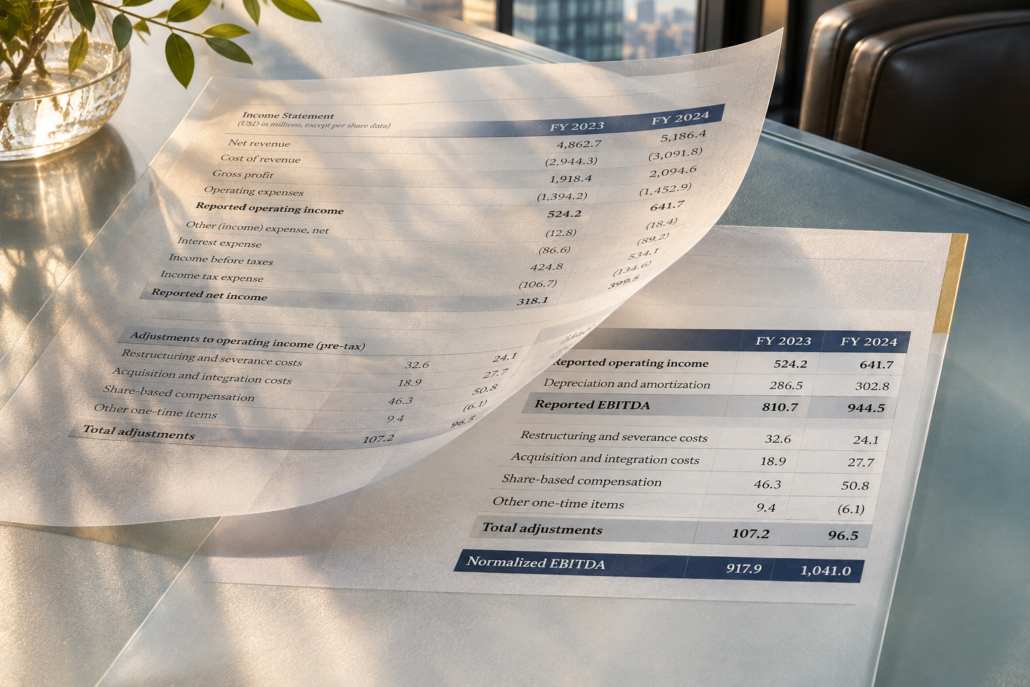
From Reported Earnings to Normalized EBITDA
A company’s historical financial statements tell buyers what happened. However, they may not accurately represent the earnings a buyer expects after closing. Privately held businesses often contain expenses, income, or accounting treatments that require further analysis. Normalized EBITDA adjustments help identify the company’s representative operating performance.
The process begins with reported earnings. From there, an M&A advisor evaluates financial results and identifies items that may not continue under new ownership. For example, an owner may receive compensation significantly above or below a market rate. Adjusting compensation to market levels may provide a more representative earnings picture. Likewise, owners may run personal or discretionary expenses through the business. These expenses may include automobiles, travel, insurance, or other owner-related benefits.
Nonrecurring expenses may also affect reported earnings. Litigation costs, relocation expenses, unusual repairs, or one-time professional fees may warrant adjustment under appropriate circumstances. Conversely, normalization is not limited to adjustments that increase EBITDA. Nonrecurring income or unusually low expenses may require downward adjustments.
Common categories of normalized EBITDA adjustments include:
- Owner compensation and benefits
- Related-party transactions
- Personal or discretionary expenses
- Nonrecurring income and expenses
- Non-operating income and expenses
- Related-party rent above or below market
- Unusual accounting treatments
- Other items unlikely to continue after closing
Each proposed adjustment should be reasonable, supportable, and relevant to the transaction. Buyers rarely accept adjustments simply because a seller labels an expense as nonrecurring. Instead, sellers should provide documentation supporting the nature and amount of each adjustment. Invoices, payroll records, contracts, leases, and financial statements may provide useful evidence.
More specifically, adjustments should reflect the expected economics of the business under new ownership. They should not create an artificially favorable representation of future performance. This distinction becomes particularly significant when buyers apply a valuation multiple to EBITDA. Even a modest adjustment may materially affect indicated enterprise value when multiplied several times. For instance, a supportable $100,000 adjustment affects value beyond the adjustment itself. At a 5.0x multiple, that adjustment represents $500,000 of indicated enterprise value.
Still, sellers should expect buyers to scrutinize every adjustment during due diligence. Aggressive or poorly documented adjustments may undermine credibility and create disagreements later in the process. For that reason, an experienced M&A advisor should identify and support adjustments before presenting the company to prospective buyers. Doing so creates a more credible financial presentation and reduces avoidable disputes.
Properly developed normalized EBITDA adjustments help buyers and sellers evaluate the same underlying earnings base. That common starting point supports more informed discussions about value, price, and transaction structure.